Friday, July 18, 2008

Weekly High Five #8 * Special Edition *

Compared to last week this week has seen a huge amount of new images added to the Photo-Africa Stock Library. Everything from Wild Dog to Abstracts and then of course in between all the great images - the Weekly High Five.

If you have just stumbled across this Blog for the first time (Welcome!) here is, in a nutshell, what the Weekly High Five is all about.

Over twenty photographers contribute African Wildlife and Nature images, taken in the wild, to Photo-Africa. (Want to start contributing? Contact me!) Every week I look through the latest uploads and chose five or more images that stand out either for their photographic qualities or the fact that they capture a unique bit of Africa's natural heritage. The ideal is of course for an image to have both technical qualities and raw emotion but these images are far and few in between even though we are getting more and more of these images being uploaded. Absolute African magic in a single frame!

So without further delay here goes with this week's High Five!

Image 1 - Lion Approach by Gerry van der Walt

I used a cropped version in an earlier post this week but I feel this image still has that something special. Normally an image where the subject is placed dead center does not have as much ‘punch’ but this approaching lion still makes an impact. I think what helps the image is that the background is blurred enough not to distract from the subject and that tree line at the back gives you a feeling that the lion is moving from there towards you. A great image of a lion in its natural environment.

* * *
Image 2 - Pangolin by Grant Marcus
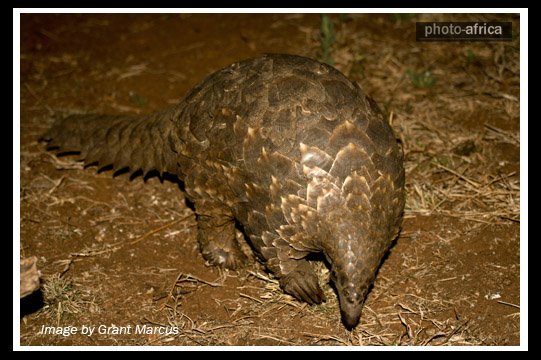
As you will recall Gavin Tonkinson uploaded a Blog on the Pangolin sighting some of the guys had in Madikwe a few days ago. Grant was also there and was able to capture this image. I like the detail on the scales on the upper back of the animal. It would have been amazing if the Pangolin would play along and lift his head for a few images but the scarceness of this animal and the fact that this image had to be taken in the evening with flash puts it in this week’s High Five.

* * *

Image 3 – Ditaba Looking Over the Shoulder by Gavin Tonkinson

This is Ditaba, one of the largest and most dominant lions in the Madikwe Game Reserve. It is always a truly rewarding experience to see an animal like this, who is in his prime, in the wild. This image captures the essence of this ‘King of Madikwe’. The head up and looking over the shoulder with such a relaxed look in his face makes this a great portrait. Very well captured.

* * *

Image 4 - Elephant Sunset by Gavin Tonkinson

This was a very strong contender for my favorite of the week. It is amazing how much mood and African atmosphere there is in this image! The colors, the silhouettes and the birds check almost all of the boxes. If there is anything I would change, and this is really nit-picking, is that the elephants and dead tree could be further to the right of the image as there is a little bit of dead space on that side. This would however have meant putting the ellies and tree in front of the black mountain which might have lost a bit of impact. In situations like this you don’t always have the option of moving more to one side of further back. You have a few seconds to capture that magic moment which, in this case, was done very very well!

* * *

Image 5 - Flying Sunset by Craig Muller

Beautiful capture. It is not easy to capture birds in flight and to get this amount of color into the frame as well is quite exceptional. I would have (nit-picking again) placed the bird and reflection off center so that there was active space for the bird to fly into but overall a stunning image.

* * *

Image 6 – Wild Dog Background by Grant Marcus

I am not sure what this would have looked like in color but I absolutely love it with the sepia tones. The dappled shading in the background makes it a very striking image and the shade also mimics the coat pattern that you find on a Wild Dog. The diagonal lines on the road, where the dog is resting, gives it a slightly dynamic feel and this again is complimented by the dog also looking in that direction. Great use of lines and sepia tones.

* * *

Image 7 - Dusty Elephant by Gavin Tonkinson

Brilliant image! You cannot place the elephant better (on one of the power points). The colors in the image get complimented by the dusty mood in the scene. There are diagonal lines which draw your eye form the left of the frame towards the focal point and the little bonus for me is the little cloud of dust at the elephant’s feet which shows you that he is moving into the African sunset. An easy choice for my top image of the week!

Even though there were a very large number of images uploaded to the Photo-Africa Stock Library, these images stood out. An amazing collection of African wildlife images in this week’s High Five. I look forward to hearing which is your favorite image of the week!

And now for the 'Special Edition' part...

As you will probably now today is Nelson Mandela’s 90th birthday and I would like to take this chance to also wish this great man a Happy Birthday from Photo-Africa!


Nelson Mandela celebrating the Springboks World Cup victory in 2007.

Nelson Mandela with Springbok rugby player Bryan Habana (perhaps good luck for tomorrow's match against Australia!)


Nelson Mandela as the world knows him! Happy Birthday Madiba!!

He has lived a truly amazing life and has been an inspiration to many people. To that end I want to end off this Blog and leave you with the closing lines of Nelson Mandela’s inauguration speech made in 1994. With everything happening in Southern Africa, and the world, these words still hold true.

“We understand it still that there is no easy road to freedom. We know it well that none of us acting alone can achieve success. We must therefore act together as a united people, for national reconciliation, for nation building, for the birth of a new world. Let there be justice for all. Let there be peace for all. Let there be work, bread, water and salt for all. Let each know that for each the body, the mind and the soul have been freed to fulfill themselves. Never, never and never again shall it be that this beautiful land will again experience the oppression of one by another and suffer the indignity of being the skunk of the world. Let freedom reign. The sun shall never set on so glorious a human achievement! God bless Africa!”
~ Nelson Mandela

As always I look forward to hearing from you

Gerry

Tuesday, July 15, 2008

Wild Earth - A Different Kind of Wildlife Photography

I have not been out in the field for a week or so now but, thanks to Wild Earth, yesterday (and please don't take this too seriously) I was able to capture the following wildlife images.


Not images I would print and frame but the results of a Wildlife Photography computer game called "Safari Photo Africa - Wild Earth".

Now I do not spend much time playing computer games or any of those kind of those things but this caught my attention. After getting a copy I gave it a try and it was actually quite a lot of fun. The basic idea is that you go on assignment in the Serengeti and your 'guide' tells you which direction to go and what images you are looking for. This ranges from the big guys like lions all the way down to a hyrax on the rocks and elephant tracks next to a river.

Once you have captured all the necessary images you go b
ack to camp where you can sort your images and then the articles gets published which you can then view in your web browser. The articles, and guide's comments, are very accurate and includes a lot of information on all the species that you find in the game. The articles that get published after each assignment is done in 'magazine format' with various images that you had to capture used to highlight the various parts of the written text.

I don't think I'll spend days playing this game but it surely beats the hell out of solitaire should you ever have to kill a few hours. Very informative, great fun and something I would advise anybody who is keen on African Wildlife to check out.

Another 'Wild Earth' you should check out if you are into African Wildlife is WildEarth TV.

This WildEarth site streams live video footage from the Djuma Game Reserve in South Africa. Every morning and evening you can join the live game drives where a guide will take you on a drive into Djuma to search for all the wonders that is hidden in the African bush. In between the drives you can watch the live feed from the waterholes on Djuma to see which animals come along for a drink.

If you are a keen African wildlife, or wildlife in general, fan I would recommend having a look at the Wild Earth computer game and also stopping in for a drive with WildEarth TV once in a while. You can link straight to WildEarth TV by using the links on the side of this Blog.

Another way to get your daily dose of African wildlife is to visit this Blog on a regular basis. Some of the images that have been uploaded to the Photo-Africa Stock Library is truly amazing which means this week's High Five promises to be a great one!!

As always I look forward to hearing from you!

Gerry

Lost & Found Images

I was hoping to get a few images when I visited the Pilansberg Game Reserve over the weekend. This was unfortunately not the case as the weather was terrible and game viewing was pretty, make that very, slow. Was a great break and had a great time never the less.

When I got back I was clearing up my memory cards and found a 4GB with a number of images that I completely missed since returning from Madikwe. This is a first for me and I suppose things have been quite hectic on other fronts which caused me to miss around 50 images.

Have been looking through these images and will be uploading quite a few to the Photo-Africa Stock Library in the next few days! Hey, I might not be in the bush right now but I still get to upload images!!

Here are two of the 'Lost & Found' images as a small preview!


Yeah, still a lot of lion images but I was very happy with the way these images turned out. Visit the stock library for more!

As always I look forward to hearing from you!

Gerry

Article: Using a Flash Outdoors

Whenever I find an interesting article that might be of interest to photographers and / or wildlife enthusiasts I will post the link in a short Blog.

The latest one I found very interesting and helpful was on a Blog that is already on our Favourite Blog List - Your Photos Tip.

This Blog is definitely worth a regular visit as they offer short, concise tips on photography. The latest article is called Using a Flash Outdoors. To read this article now click here.

An older article, also on Your Photo Tips, was called Easy Lighting Tips for Outdoor Photography. Click here to visit this article now.

I will be posting a lot this week so make sure to visit again soon! Enjoy the reading!

Gerry

Saturday, July 12, 2008

Weekly High Five #7

I have just finished watching the rugby match between South Africa and New Zealand.  I could carry on about this but all I can say is UNBELIEVABLE match!!! :)  


Anyway, back to business.  This week has been one of the slowest as far as uploaded images goes but there were still a great number, more than forty,  of amazing images added during the week.


As you might know I have been in Johannesburg which has not been the most conducive thing when it comes to Wildlife Photography and the weather has also been miserable which kind of canceled the idea of photographing birds in the garden. 


Have been missing being out in the field and that influenced my decision for this week's High Five.  The following images show a lot of the moods and scenes of Africa.  I enjoyed them and hope you will too.


Image 1 -  Old King by Gavin Tonkinson


Beautiful sepia tones bring the contrast out in this male lion.  Even at a slightly advanced age you can still see how proud he is.  There is perhaps a little bit too much space at the top of the frame but not enough to detract from a great lion image.


* * * 


Image 2 - Colour by Bradley Leighton


 Colour.  Plain and simple.  For any macro you want to make sure that you do not have a distracting background and that you subject is in perfect focus.  This image is a great example.  The colours on the petals lead your eye into the middle of the image perfectly.  The only issue I could find is the little highlight of white on the right side of the frame which is slightly distracting but something Photoshop could get rid of quite easily.


* * * 


Image 3 - Hyena at Carcass by Gavin Tonkinson


Great African scene.  The stance of the hyena captures perfectly the awareness shown by Spotted Hyena and the background allows for the focal subject to stand out.  It is a very 'usable' image as even though you can see that it is a kill there is no red blood and guts which detracts from the overall scene.  There is a time for blood and guts in an image but it is not something you want to overuse.  It is a scene like this that, if you have not been for a while, makes you miss being out in the field.


* * * 


Image 4 - Kill Chaos by Bradley Leighton


As with the previous image another scene that captures the mood and action of the scene.  At a scene like this you might have more than a hundred vultures all scrapping for the last bit of meat.  I like this image as you get the feel for how busy it is around the carcass and you cannot really see how many birds there are as they all seem to blend into each other.  Not sure if the bird on the right hand side of the frame bother me... Nah.  All over a great image.


* * * 


Image 5 - Golden Zebra by Gavin Tonkinson


Stunning use of light in this image!  A moody, almost abstract scene that works very well.  How many times have you tried to capture wildlife with back lighting?  It is not the easiest thing to pull of successfully.  And then you subject does not want to hold still.  By making the focus of the image the actual light and not the animals this image shows what photography at the beginning and end of the day can be all about.  The rim lighting around the zebra's mane and the way it catches the grass is perfect.  It does not even bother me that the zebra at the back has been cut off.  The fact that there is no direct light on him and the way in which the body creates a very nice depth to the image is brilliant.  Absolutely beautiful image!  Without a doubt - this is my image of the week!


A much simpler selection then some of the previous weeks but it shows how diverse Wildlife photography can be.  You don't always need the lion chasing a wildebeest or a leopard up a tree.  The challenge is to capture the beauty that is around you all the time!  I look forward to your comments on these five images.


Well, I am off to the Kwa Maritane in the Pilansberg Game Reserve tomorrow morning.  Nothing major.  Actually just going to join my parents and sister for lunch and then staying over for one night.  Only one day but hopefully I will have some new images of my own to upload when I get back.  Watch this space!  


As previously mentioned, I will be uploading the Blogs on Composition and Exposure sometime during next week.  In the meantime, you can view all the new images that has been added this week by visiting the Photo-Africa Stock Library. 


As always I look forward to hearing from you! 


Gerry


Friday, July 11, 2008

Pangolin!!

Last week was one of those unforgettable days in the bush when out on the afternoon safari everything just falls into place…


Firstly the Diperoro leopardess which has been making her grace felt more and more regularly, popped out into the road in front of us, to be greeted by my guests with massive excitement and awe as this majestic cat strutted her stuff in true cat fashion before disappearing into the thick undergrowth.


After the euphoria of sighting one of the most elusive creatures in the Madikwe Reserve, we continued the safari with countless sightings of general game, and a plethora of bird species entertaining us with a splash of color every now and then.


Not long after the leopard sighting, we bumped into the Tshaba Lioness on her own looking intent on finding something to hunt, with a serious glint in her eye which had that “I mean business” look. There were some wildebeest in the area which she pursued and then also vanished into the thickets, only to return a half hour later with all her youngsters greeting her with hopes that she had caught something, but alas, it was not to be…


Then elephants at Tlou dam, quenching the days thirst  with white rhino as the backdrop, all happening as the sun was setting, but wait that wasn’t all…


As we were about halfway through our drinks break, Ryno (one of the other Guides) was approaching us when he suddenly shouted from about 80 meters away “PANGOLIN!!”, and I said, “WHAT !?”…


”PANGOLIN!!”


Needless to say I shouted to the guests to get in the vehicle, and the cooler box with snacks and all was in the vehicle in about 3 and ½ seconds flat. The following Images were unfortunately not the best quality, but to see something like this is only the third time in 9 years of my guiding career, so I will leave you with some info on these secretive creatures…..


Scientific Classification

Kingdom:  Animalia

Phylum: Chordata

Class:  Mammalia

Order:  Pholidota

Family: Manidae

Genus: Manis

Species: M. temminkii


The Ground Pangolin (Manis temminckii), also known as Temminck's Pangolin or the Cape Pangolin, is one of four species of
pangolin which can be found in Africa and the only one in southern and eastern Africa. Although it is present over quite a large area, it is rare throughout it and notoriously difficult to spot. Its scarcity is partly because it is hunted by humans for its scales, which are used in love charms, and partly because it is often burnt in bush fires. The IUCN only lists it as "near threatened" on its Red list.


With the exception of the underside, it is covered in extremely hard scales. When threatened, it usually will roll up into a ball to protect the vulnerable belly. The scales on the tail can also be used as blades to slash at attackers.


The Ground Pangolin can grow to a length of about 1 meter, with the tail typically between 30 and 50 cm. It has a disproportionately small head, powerful hind legs, and small forelegs.


Like other pangolin species, it is largely nocturnal, although it is also entirely terrestrial and usually found in savanna or open woodland, generally feeding on termites or ants. It is well adapted to this, with a very long (up to 50 cm) sticky tongue which is stored inside a pocket in the mouth until needed. Although it is capable of digging its own burrow, it prefers to occupy disused holes dug by a Warthog or an Aardvark or to lie in dense vegetation, making it even more difficult to observe.


This animal was named for the Dutch zoologist Coenraad Jacob Temminck.  Pangolins lack teeth and the ability to chew. Instead, they tear open anthills or termite mounds with their powerful front claws and probe deep into them with their very long tongues. Pangolins have an enormous salivary gland in their chests to lubricate the tongue with sticky, ant-catching saliva.


Cheers for now!


Gavin Tonkinson

Wednesday, July 9, 2008

Lines & Shapes in Wildlife Photography

I am currently in Johannesburg and will only be returning to the Madikwe Game Reserve towards the end of the month.

This has left me with quite a bit of time to look through old images, make updates on the site (thanks to Mike from FenPhotography for some tips on image sizes in the Blog - larger images look great!!) and just in general miss being out in the field!

I have been doing a lot of reading which, combined with the fact that I am stuck in the concrete jungle, led me to do this Blog.

You know when you like a picture. You might not know what it is that makes you like it. You just like it. Over the next few weeks I will look at various of the images that have been uploaded to the Photo-Africa Stock Library and pull them apart with regards to composition, exposure and other factors that we all read about in Photography magazines and hear about in courses.

So let's start with a look at Lines & Shapes in wildlife and landscape images.

Like anything you need to train your eye to see lines in shapes while composing your images. In wildlife photography this is sometimes quite, cancel that, very challenging as you are in the wild and "the damn lion just won't play along!!"

It is however still good to try and keep lines and shapes in mind when looking at an image through your viewfinder. Before we look at a few sample images a quick breakdown.

Diagonal Lines
Diagonal lines are definitely the most interesting lines you can use in a photograph. The addition of diagonal lines in your image creates a kind of a conflict that is visually exciting and makes for a much better all-over image. They can be used to lead the viewer's eye into and out of the image or highlight your focal point.

Vertical Lines
These lines gives a very dynamic and strong feeling to an image. Height can be conveyed with these lines and will normally go along with a portrait rather than a landscape image. The height of the vertical line will be echoed by the long side of your frame giving a visually appealing feeling to the image.

Horizontal Lines
One to be careful of. Vertical lines tend to be a lot more calm and peaceful than the other types and will normally be used in landscapes where the horizon runs through the frame. First off, if your horizon is skew - images gone! You must also make sure to not cut your image in half by putting the line dead center in the frame but rather raise or lower it when shooting to emphasize your focal area. I.e. move horizon down the frame to focus on the beautiful sky.

Shapes
By combing the mentioned lines you can create shapes. Square or a rectangle that mimics your frame is not as visually appealing as something like a triangle that creates a bit of conflict in the frame. It keep is interesting and comes back to the rule-of-thirds which also relates to 'everything in threes' but more on that later.

So with that in mind here are a few examples of how lines can be used to create great wildlife and nature images.

Example 1

A great image of a Madikwe Sunset. Apart from the colors that are very appealingly, the use of lines makes this a great image. The breakdown:

The horizontal line has been used perfectly - a straight line that has been dropped slightly below the center of the frame to keep the focus on the sky. The repetitive diagonal lines in the clouds keep it interesting and almost pushes your view to the bright golden clouds in the right of the frame.

Example 2

Great landscape of a dead tree. Taken slightly from below, the height is emphasized and the diagonal lines all lead your eye to the focal point - the clouds. The breakdown:

Great use of lines. The diagonal foreground finishes the image nicely at the bottom and starts moving your view up the tree. The vertical line of the tree gives it nice height and the the diagonal lines formed by the branches lifts your view up towards the clouds. It almost looks like the branches are 'carrying' the clouds.

Example 3

A very normal landscape image that has 'something'. It makes you want to look to the right of the frame. The breakdown:

The winding road leads you, whether by s-curve shape or combined diagonals, to the blue sky. The 'movement' is assisted by the trees all leaning in towards the open area. The red diagonal lines assist the movement and the green diagonals (or s-curves) keep your eye moving to the top right of the frame. The white lines show the 'power points' of the image (where the white lines cross - according to the Rule of Thirds) and is very close to where all the lines lead your view.

Example 4

An interesting image of a person next to a tall tree. The image definitely conveys height and you truly get to see how tall the tree is. The breakdown:

By combining the vertical lines, portrait layout and the person next to the tree for comparison you get to see how tall the tree really is. If this image was a landscape without the person in the image it would have been damn near impossible to get any idea of how tall the tree is. Another nice aspect (not illustrated) is the horizontal line that gets created by the rocks in the top of the image. Finishes the image of nicely.

Example 5

A striking image if a Shaft-Tailed Wydah on a dry tree. The breakdown:

Firstly the focal point, the bird, is placed perfectly on one of the power points (will do a Blog on this later when looking at composition). The use of diagonal lines and the triangle shape gives this image that 'little bit extra'. The triangle makes, as always, the image a little more exciting. The diagonal line all work together to highlight the bird. Great example of using lines & shapes in wildlife photography.

A lot of the times when photographing wildlife you will not have time to check for lines and shapes as you need to try and keep up with the action. Over time your eye does get trained and you see these lines and shapes much quicker so the old saying still holds true - practice makes perfect! It is those times that you do include it, whether planned or just by plain luck, that an image will have that little bit extra and stand out above the rest. Something to think about next time you go shooting wildlife and landscape images. Will have a look at some of the images on Photo-Africa and next time look at all the various factors influencing Composition and after that Exposure.

One more thing before I finish off. Why is it that people want to change their camera bodies more than I change my socks? The moment a newer camera body gets announced they just have to have it! Hey, I like my toys as well but damn! Have you used even half of the functions on your camera? Are you ever going to actually to print anything that big that warrants you having one extra megapixel? Do you have any idea how the bracketing feature on your camera works? Do you really need to shoot at 9 fps when photographing your cat or grandmothers cakes? All on automatic?

It feels to me that for someone, who does not shoot professionally, to get a newer camera body "to take better pictures" is like a fish getting a bicycle to swim better... It does not make sense!!! Why not rather spend money on a lens or a course of sorts so that you can learn to take better images with your current body? Just a thought... and with that I'll get off my little pedestal and go and see what is for lunch! :)

As always I look forward to your comments!

Until next time!

Gerry

Monday, July 7, 2008

Weekly High Five #6

The challenge for any wildlife photographer is to tell a story. To share a moment. To create a connection between people and nature. It is to be out in the field sharing time with the things we love while at the same time respecting the power of nature as you try to get the best images in very challenging conditions.

As you look through this week’s High Five I want you to keep in mind that all the images found on Photo-Africa has been taken in the wild areas of Africa.


I believe it takes a special kind of person to spend days at a time in the field looking for that one special moment where technical expertise meets natures beauty. It can get very frustrating at times but then it only takes one image to make it all worthwhile.


When I look through my images after a shoot I am very critical and probably only end up with one decent image out of every fifteen! How many images must be in a box or pc directory somewhere that was deemed “not good enough”? Every once in a while I go through my old RAW files and find images that I can just crop slightly or alter the histogram to make it a usable and pretty good image.


With the Photo-Africa Stock Library approaching 2000 images there must be a couple of brilliant images that snuck through the sorting process as the photographers chose their 'good images'. Come one guys. Let's see some of these oldies as well!


Hopefully these will surface at some point but for now here goes with this weeks High Five.


Image 1 - Otter and Lions by David Trevor Guest


I added this one due to the story that it tells. The two male lions was looking for a place to cross the Marico River. As they approached the drift where they normally get over the running water a Cape Clawless Otter popped up and just stared at them. The lions apparently had one helluva fright and did not quite know what they were dealing with. The Otter was almost daring them to enter his domain and the lions only crossed the river once their little gate-keeper left. Not the most striking image, technically or composition-wise, but one that tells a story.


* * *


Image 2 - Madikwe Sunset by Bradley Leighton


A great capture of one of the best times of the day. I am in the process of writing a Blog on technical considerations when looking at the composition of nature and landscape images and this one knocks it on the head. By keeping a bit of the foreground in the image you get a feel for how majestic and 'large' the sky looks during this time of the day. If Bradley added more of the dead, black foreground it would have taken to much attention away from the sky. Great African sunset image!


* * *


Image 3 - Wild Dog Eating by Gerry van der Walt


When capturing any animal - it's all in the eyes! It's not so visible on this image but the eyes of the Wild Dog make this image. The color might look like it lacks a little saturation but it shows perfectly what the Southern African Savannah looks like during mid winter. This Wild Dog was feeding on a recently killed Impala and looked up just long enough for the shutter to be clicked.


* * *


Image 4 - Elephant Head by Gavin Tonkinson


When an image makes you look twice it is a winner. Gavin waited for the elephant to close his ears before capturing this image. You kind of struggle to picture which way this ellie was looking and combined with the color, texture and lines makes this a great image!


* * *


Image 5 - Lion Sepia Scene by David Trevor Guest


Great moody scene which is helped on by the sepia tones. If anything I would have tried to move the lion a little lower down from the tree line (but then it IS wildlife photography in which you do not always have those options) which would have emphasized him a lot more but still a great African image.


* * *


Image 6 - Lion King by Gerry van der Walt


Beautiful Lion image and again the eyes have it. Light is great. The slightly raised head and full mane give him a very majestic look. An almost perfect lion portrait.


* * *


Image 7 - Red Rhino by David Trevor Guest


Even though it has been slightly edited in Photoshop this is my pick of the week. Even in full color this image would have worked. The two rhinos have been placed perfectly in the frame and the open mouth gives it a dynamic feel. The desaturated of all the colors makes the faces and horns of the rhino pop and draws attention to the main focus of a rhino image such as this. I like it!!

Another great group of images for this weeks High Five.


Remember that all these images were taken in the wild!


To view more of the new images you can visit the Photo-Africa Stock Library and make sure to visit the Blog again soon as I look at various factors that influence the composition of your wildlife images!


As always I look forward to your comments!


Gerry

Sunday, July 6, 2008

Images of a King

As you might know from previous Blogs I have been searching for the Kgala males during my recent stay at Morukuru.  Initially we only found the females, then tracks of the two males and when we eventually found the two big guys I had issues with my resulting images.


Now that I have returned home for a short while I have been working through the all my RAW images I ended up getting of these two beautiful males and have been really pleased with the results.  These two lions, who are around seven years old, is the perfect example of why lions are called the ‘King of Beasts’.


So after a lot of walking and driving I finally found them and as promised, here are a just few of the images of the Kgala Males from the Madikwe Game Reserve that I was able to capture during the last ten days.


Images of a King


I would love to hear your feedback on these images which has already been added, along with many others, to the Photo-Africa Stock Library.


I will be finalizing the Weekly High Five today and tomorrow and hopefully have it uploaded by Monday afternoon so visit again soon!


As always I look forward to hearing from you!


Gerry

Saturday, July 5, 2008

Coming Soon

Adele and I will be in Johannesburg for the next three weeks, until 1 August, when we start our new positions but more on this a little closer to the time.  

I have just uploaded a lot of new images to the Photo-Africa Stock Library but still have many more to work through.  Combined with getting ready to move and getting the High Five together I have quite a few small things to take care of.  

I am also looking into ways in which to get larger images loaded onto the Blog which will make for a much better quality photo showcase. 

I will be uploading the Weekly High Five along with a few other Blogs during the next few days so make sure to check back soon!

As always I look forward to hearing from you!

Gerry

Tuesday, July 1, 2008

Feeling Better!

Much better!  Colour, saturation, histogram.  All much better!


I had a quick look through the images I got after my previous Blog and definitely a huge difference!


I still don't think it was any one of the settings I was using but rather a small combination of many of them.  Sometimes we forget to check the basics!  Had quite a bit of time to play around yesterday afternoon and even at first glance much better results.  Lesson learnt!! :)


So with that I feel a bit better about heading off on a day-drive today and also sitting down at the end of the week to work through all the images of the last few weeks.


As always I look forward to hearing from you!


Gerry