Monday, December 29, 2008

What If...

What if...

Whether in photography or life in general, these two words can potentially carry huge meaning. 

In photography these two words could be the difference between an absolutely amazing image and a very average snap shot.  When used in retrospect it is too late and there is then nothing than can be done to get another chance but when you think of it before you click the shutter you open up your mind to all the possibilities that are locked up in 'what if' you can create magic.

What if the blade of grass and leaf was not covering this young leopard's face?  Would it have been a better image?  Probably, but it really does not matter as there is nothing you can do about it now.  The image has been created and that is that.  A quick 'what if' before the shutter clicked might have led to a different outcome but then again hindsight is always nice and clear.  (I still like the image though!)

Now depending on your point of view on the age old cliche art imitates life and, whether for good or bad, those two little words are also a part of our everyday lives.  Would it not have been easy if, like in photography, we can ask 'what if' before decisions get made.  Before we speak to someone.  Before life forces you to move on.  

It seems way more likely that most of us will face those two words in retrospect as during this time of year we start looking forward to looking back.  New resolutions.  New goals.  New dreams.  

For whatever reason we all have to deal with our own 'what if' questions, however difficult they may be.

What if I said it?
What if I did not say it?
What if I listened?
What if I did not listen?
What if I told that one person how I really felt?
What if did not give up?
What if I did?
What if he was still in our life?
What if I accepted that offer?
What if I had the courage to stand by my own convictions?
What if I am better than I think I am?
What if it really is possible?
What if...

Life is not always black and white.  Yes, there are things that are right and wrong but people's differences, personalities and ideas add color to our everyday life.  When you can combine this color with a respect for old-fashioned values you will be able to live life to the full and not be afraid to face your 'what if' questions.

At the risk over too many cliches, life really is too short.  

On a personal note, I feel there are things that I would have done slightly differently but I am grateful to say there are no regrets.  There are most definitely a few key moments in life I might have decided to negotiate differently but the road these decision has led me on has been amazing so even if there was regret life found a way to make up for it.  New possibilities.  New ideas.  It has been quite a ride but it is not over yet.  In a very short time from now it seems things might change again.  As long as I do not sit back one day thinking 'what if I made a different decision' - bring it on!

As you look back at 2008 treasure the memories and look forward to another chance.  In 2009 live life to the fullest.  Tell that person how you feel.  Go climb that mountain.  Take that trip.  Take more pictures.   Make the change.  Follow your heart.  Follow your dreams.  Do everything you need to do so that when you get to this time next year there won't be any 'what ifs'. 

Thanks to everybody for their support during this year.  With a lot of things planned for the New Year I look forward to sharing more images.  More stories.  More of life.  It has been a helluva ride but buckle up because here we go again...

All the best for 2009.  Make it count!

Until next year!

Friday, December 26, 2008

Ten 'Great' Photo-Africa Images - 2008

What makes a great image?

If you ask 100 people you are going to get 100 answers.  It is most definitely a personal choice but there has to be something that can be found in great images.  Something that, whatever your point of view, demands the viewer's attention and makes you look at the image again.  

Various dimensions like technical quality, composition and other photographic 'rules' can be thrown around but is it truly possible to place a series of criteria and regulations as to what ultimately makes a great image?  I don't think so.

A great image should excite you.  A great image demands a second look.  A great image should capture the essence of the moment which can then be seen and felt by the viewer.  A great image will still be a great image in 20 years.  In 100 years.  If you as the photographer can moved past the point where you worry about mastering technique and your equipment you are in a position to finally start creating great images.  Images that you see in your mind before clicking the shutter.

Wildlife photography is no different.  My initial idea was to, for this final High Five post of 2008,  go through the images on the Photo-Africa Stock Library and choose a Top Ten of sorts.  Obviously I was very optimistic as I have not even gotten through a quarter of the images.  

Instead I went to the Most Popular images, based on amount of views on the site, and chose ten images from there to feature in this post.  As I was looking through the small thumbnails I chose the images that, even as a small preview, caught my attention.  Isn't that what it is all about?  For an image to catch your gaze no matter what the size?  

I don't think all the images on the Most Popular page are great images.  In my opinion some of them are pretty ordinary but people's preferences differ.  A good image to me might be a masterwork to you.  A great image surely then has to be the one that, no matter what your background, preference or mood, stands out and demands your attention.  

So as the final High Five of the year, here are in no particular order a number of great images that have been uploaded to Photo-Africa during 2008. 


These images are all very different but great in their own way.  Have a look at each images and choose only one word to describe it.  Passion.  Tension.  Power.  Beauty.   If you can do this I believe an image has what it takes to be 'great'.

At the end of the day beauty is in the eye of the beholder.  If your vision is true to yourself great images will create themselves.  Shoot with your mood.  Shoot with your feelings.  Shoot like you want to and you are on your way to create great images.

During January I will work my way through the images on the Stock Site and post my real Top Ten for 2008.  For now you can visit the following two links to view the ever-growing database of African Wildlife and Nature Photographs on the Stock Site.  Even during the festive season more than 100 new images have been added.  Absolutely 'great' stuff rolling in!


What do you think makes a great image?  Is it just one thing?

As always I look forward to hearing from you!

Until next time.

Spot the Wild Dog

With being one of Africa's most endangered carnivores, the Wild Dog is notoriously difficult to find and keep up with.

The dog below thought he should make it even more difficult as he sat in an old farm dam while another three dogs were scouting around for impala. 

After he came out of his morning hiding place we followed them around for a while as they ran all over the place after, by now, very paranoid impala.  In the end we lost visual as they moved off into the thick bushes after another possible meal.

As always I look forward to hearing from you!

Until next time.

Thursday, December 25, 2008

An African Christmas

Christmas and New Year normally means a nice long holiday spent with friends and family.  This is not quite the same when you work in the lodge & hospitality industry.

During this time of year most lodges in Africa are completely fully booked.  For the management, guides and staff this means a very busy time as you create special memories and wonderful experiences for guests.  Normally this goes hand in hand with working long hours without having the chance to see family and celebrate the holiday as you normally would.  I truly take my hat off to the people working over this time of year!

During the day you find yourself looking at the people on holiday as they celebrate the togetherness and spirit of the festive season.  Somewhere deep down inside you feel conflicting emotions.  These feelings pendulum between a sad longing to also have the opportunity to share special moments with friends and family and a feeling of satisfaction of having created another moment, another memory for someone else.  

Right now these memories are made up of adventures in the African bush, great meals and the warm hospitality where every little detail comes together to create a kind of magic.

During the last few days of 'silly season' the game viewing at Tuningi has been spectacular.  The last four groups of guests have all seen the Big 5 a couple of times over and the pack of Wild Dog have been very kind to give us the most spectacular sightings.

As we sat watching the sunset below on Christmas eve it was a strange kind of way it feels great to be a part of the memories that some people will hopefully carry with them for a long time to come.  

The only other feeling that is always there is that next year or the year after we will also be able to create memories with family and friends but for now we continue to do what we do and create magic for our guests - a feeling that, for now at least, is worth all the time spent.

I hope you have a Merry Christmas!

Until next time!

Sunday, December 21, 2008

Season's Greetings!

Friday, December 19, 2008

Weekly High Five #26

It is amazing to think that this will be the second last Weekly High Five for 2008.

For those of you that are new to this Blog here is how it works. The Photo-Africa Stock Library features a growing database of African Wildlife & Nature images. These images get uploaded by more than 25 wildlife photographers and field guides working in Game Reserves all over the African continent.

All the images have been taken in the wild and shows Africa through the eyes of people who care enough for nature and it's wildlife to capture the beauty and magic that is Africa. With many of the contributing photographers working in Game Reserves and witnessing the most amazing sightings every day , the images form a part of one of the most unique and regularly updated showcases of African Wildlife & Nature images on the Internet. All these images can be viewed on the Stock Site and is available as non-licensed commercial, editorial or personal use.

Every Friday I choose five of the latest images that have been uploaded to the site and feature them on the Blog with my thoughts on what makes these images stand out while always keeping photography and wildlife in mind.

With this being the 26th edition of the High Five, I have featured 130 images from the more than 3000 images on the Stock Site. For next week's edition, which will be the last for the year, I will choose my top ten favourite images of 2008. I know that as I am writing this it is going to be a very difficult thing choosing only ten but it will be interesting looking through the images all the way back to when the Stock Site was started in April this year.

Make sure to check in next week for Photo-Africa's Top Ten Images of 2008, but for now here goes with this week's High Five.

* * *

Image 1 - Shaking Spurfowl by Matt Jones

Interesting image. This Natal Spurfowl is busy shaking himself clean after a dust-bath when Matt clicked the shutter. The head is slightly out of focus but still assists in creating a dynamic image of the bird in action. If the head was perfectly crisp this would have been ab even better image but I still find it fascinating.

* * *

Image 2 - Black Shouldered Kite by Gerry van der Walt

This image presents quite an interesting exposure challenge but the final result is not too bad. What makes this image work is the Black Shouldered Kite looking straight at the camera - eye contact.  The ideal would have been to have the sun slightly more from behind the photographer which would have highlighted the beautiful red eyes more but still a good bird image.  Would perhaps have liked to see more contrast but not a major.

* * * 

Image 3 - Vulture Face by Paul Benson

As far as bird close up goes this is right up there.  As with the previous image, and all other wildlife images, it's all in the eyes.  Not only is the eyes crisp and sharp but the catch light makes the image come alive.  The negative space on the right is used perfectly and gives the vulture something to look at.  Stunning image of a very difficult to shoot subject.

* * * 

Image 4 - Mating Lions by Gavin Tonkinson

This image has quite a few things going for it.  The first is, again, eye contact.  The male lion looking at you as if to say "What are you looking at?" immediately draws you into the image.  The way it looks as if the male lion is kissing the female on her head gives the image a 'cute' quality.  I am not quite sure what to make of the look on the female's face but I like it.  Kind of confused perhaps? This image also shows that you should sometimes break the rules and place your focal point in the centre of the image.  There are so many small things happening that it does not feel like your gaze is stuck in the middle of the frame.  Nice one.

* * * 

Image 5 - Hyena Battle by Matt Jones

This is easily my pick of the week.  Absolutely stunning image that shows interaction between the two species of hyena.  The dry dusty environment works perfectly to heighten the emotion of the scene as the Brown Hyena kicks up the dust.  From a previous post, this image draws you in.  It must have excited the photographer as it does the viewer.  This is what wildlife photography is all about - showing the stories that play out in nature.   Great shot!

* * * 

It is nice to see that a lot of the guys are uploading more bird images.  Overall I have been very impressed with the diversity of images that have been uploaded this year and hopefully this will show in next week's Top Ten post.

As we approach the end of the year there are a lot of new ideas and regulars I would like to add to the Blog.  If all goes to plan this will probably start coming together towards the end of January after I have met with a few potential partners and sponsors for competitions Photo-Africa will start running.  I am also in the process of integrating the Photo-Africa Home Page, Blog and Stock Site into one.  Lots of work, many ideas and still quite a few things to iron out but the process has started.  Will keep you posted!

Even though things are quite hectic for us over this time of year I will still upload a few posts during the next week before the Top Ten post next weekend.

As always I look forward to hearing from you.

Until next time.

Friday Fun - African Laxative

I received this image by email.  Not sure who took it or where but the caption worked.

"An African laxative about to start working"


As always I look forward to hearing from you!

Until nest time.

Thursday, December 18, 2008

Don't Think - Just Do it!

Photography is art. It is abstract. It is a passion.

An image should convey your passion, interest and excitement. If you are not shooting with this in mind you will struggle to produce images that make people go 'Wow!'.

You can get your images perfectly sharp with a text book histogram but it your images do not contain elements that excite you they will probably also not excite your viewers. In order to make better images shoot with feeling. Shoot with passion.

Ansel Adams said "There is nothing worse than a sharp photograph of a fuzzy idea."

Think before you shoot. Feel before you shoot. Don't click the shutter at a scene purely because it has been done before or you think it might look good as a photograph. You need to know. If your images don't 'talk' to you they probably won't 'talk' to other people either.

Technical knowledge is important but it should never get in the way of shooting what excites you. Ken Rockwell says on his site "Worrying about manual exposure settings and technique distracts you from your passion, just as if your lover were to stop to answer the phone in the middle of a steamy one-on-one. You need to worry about seeing, feeling, composition and lighting, NOT about f/stops as you start out."


Many people still believe that buying a newer, better camera will automatically help them produce better images. People make photographs, not cameras. A good photographer can make brilliant images with a very basic camera while many people with very fancy and expensive cameras fail to produce striking images as they lack passion and vision.

Here are two if the images that got me quite excited the last two days.


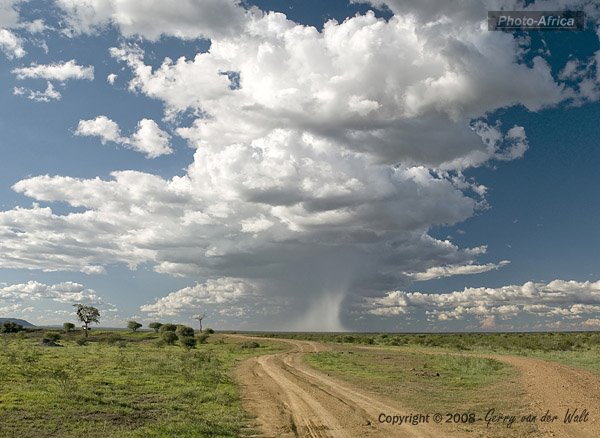
Fantastic build up of clouds over Tlou Dam in the Madikwe Game Reserve.

The front paw of a very large male lion that produces the tracks we spend endless morning walking after.

It might not always be the obvious, but shoot what excites you. Don't think about it, just do it!

As always I look forward to hearing from you!

Until next time.

Gerry

Tuesday, December 16, 2008

Madikwe's Inselbergs

If you have ever been to the Madikwe Game Reserve you will know that the Inselbergs are one of it's defining features.

This panorama shows the road on the western fence line close to the Wonderboom Gate and the Inselbergs as they stretch into the reserve from Botswana in the North. You can click on the image for a larger view.

As always I look forward to hearing from you.

Until next time.

Gerry

Time, Pride and Wide Open Spaces

In nature, as in life, you find scenes and moments that defines a certain feeling. A certain time. A certain place. Here are a few of the images I got in the last two days that I feel 'defines' but a few of the scenes and emotions you might find in the African bush.

This newly born Impala defines this time of year.

This image defines a certain feeling or emotion. Pride? Confidence? Longing?


This image defines the open spaces of Africa. This image was one of my first attempts at stitching three images together to create a panoramic view of the southern parts of Madikwe. The clouds bring a certain element of emotion. Conflict perhaps?

The rain clouds are slowly building up over Madikwe again. It is amazing how this changes the mood out in the bush. Not always for the bad though. There is a sense of expectation. A promise of renewal and the hope that the decent rains finally arrive.

Will be back with the Weekly High Five on Friday so make sure to check back again soon!

As always I look forward to hearing from you.

Until next time.

Monday, December 15, 2008

Playing With Photoshop CS4

Hello again everybody,
I have had a little time on my hands in the last week or so, and have been playing with photoshop with some of my images, and have come out with some really funky looking shots.
Now remember that you cannot just put a filter on any old image and hope that it would have to work. You must first select an image which you think can work with a particular filter, as not all images are suited for any filter.
This is obviously no means of creating the best selling image in the industry, but nevertheless will keep you occupied for for hours on end.
Anyway so here goes......
Original.

This was the result after the fractillus filter was applied, nice thing about this, is that the line sizes can bne changed to completely warp the image, or make it more realistic like this.


Original.


I created a second layer and dropped the oppacity of this image after I added serious grain to it, which gave this image a classy feel to it.


Original

This was created in on eof the brush strokes filters and gave this interesting mix...


Original.


Ater putting this image through the "Glowing Edges" filter this came out, which I quite like, and think it could print well on canvas perhaps.
I cant remember which filter I used in this image, but it came out pretty good for possibly printing on metallic paper as some form of contemporary art.

So what are you waiting for............ GO PLAY !!!
The options are endless.
Cheers,

Sunday, December 14, 2008

From Chameleons to Leopards

The week started off quite slow.

Even today the sightings have not been as numerous as we would like them to be.  Regardless of this we have been getting some pretty awesome photographic opportunities.  Here are a few random images from the week so far.

Guess it is too much to ask for to have a Chameleon look at you with both eyes and yes - I was flat on the floor.

At this time of year there are always a lot of newly born animals around.  I guess this is a face only a mother can love!

Shot this image with B&W in mind.  Quite happy with the result.

This Red Crested Korhaan was not very happy with the early morning rains.  Looks very miserable.

The Diperoro female has been giving us a few great sightings the last while.  On this particular afternoon she was very happy to pose for images.  Stunning cat!!  Will upload more to the Photo-Africa Stock Library as as soon as I get a chance to go through all the RAW files.  Gavin also has a few of this beauty which you can see on the Stock Site.

As always I look forward to hearing from you.

Until next time.

Another Rare Find

You might recall that at the end of November I posted an image of a 'PushmePullyou' Rhino.  

One of my guests at Tuningi, Mitchell, got this shot and I just had to upload it!  Another version, Zebra in this case, of Dr. Doolittle's mythical beast!

As always I look forward to hearing from you!

Until next time.

Saturday, December 13, 2008

Weekly High Five #25

There is something special about being in a Game Reserve in Africa.

Last night this was again apparent again when the guests at Tuningi were treated to a bush dinner.  Five star cuisine in the middle of the African bush.  The evening was illuminated by the most beautiful full moon which rounded off the perfect evening. 

Working in the hospitality industry and especially in the Game Lodge industry, is quite an adventure and takes a special kind of person.  The ability to always put your own wants and needs after that of the guest requires a strange and very rare mix of passion, patience, dedication and sometimes a decent helping of 'bite-your-tongue' self control.  I think that many times people involved on the fringes of the industry do not even understand how lucky they can be to have the people out in the field doing what they do.  I truly take my hat off to all the guys and girls who are creating lifelong memories for guests from all over the world when they visit Lodges in Africa. 

I find myself thinking about the future and where it is all going.  During this time of year when we all look back at the past year and make plans for the New Year I suppose it is normal to get these feelings.  Perhaps it is just this time of year.  Perhaps it is my mind looking to the future.  Perhaps something else?  I find myself in a strange place where there does not seem to be one clear path which is the 'correct' one.  The age old cliché of 'wants versus needs' seriously comes to mind.  

Do you indulge your own wants and hope that needs will ultimately take care of themselves or do you take care of the needs which will in the long run give you what you want?  I guess time will tell where this incredible adventure that is life will end up.

Whatever the future holds I know that I will always have photography.  I know that many people have written about the emotional outlet it offers so not going down that road right now.  Since a concerted effort to expand my portfolio and include various other genres of photography I have learnt a lot and feel excited about it all again.  Make no mistake, my passion is still wildlife & nature photography but there is so much more.  You look at images differently and a whole new world of possibilities open up.  As Canyon Ranch's tag line reads - the power of possibilities!

In between all this playing around I have not had much time to upload new images to the Photo-Africa Stock Library but the new material has still been rolling in.  With that, here goes with this weeks High Five.

* * * 

Image 1 - Shaking Lion by Gavin Tonkinson

With all the lens techniques I have been playing with this week I was quite amused to see this shot.  Great example of a motion blur captured with a slower shutter speed.  Two things to note.  You can see that the lion is pretty much in focus which shows how still you have to hold your camera when shooting with low shutter speed.  Another thing that makes this image work is the fact that Gavin focused in the lion's face.  You can see the motion blur forms a circular feeling around the face which pulls you gaze in that direction.  Fun image.

* * * 

Image 2 - Leopard Tortoise by Brett Hoy

Nice capture of one of the 'Small 5'.  What makes this specific image unique is that Brett got low down - eye level!  By getting at eye level, or is possible even lower, you are on your way to create dramatic animal and wildlife images.  Too many people shoot small creatures like this from the top which gives it a very 'the-human-is-in-control' feeling.  Wildlife images should highlight the animal and this image does a pretty good job.

* * * 

Image 3 - Brown Hyena Cub by Gavin Tonkinson

This image is tightly framed and initially it feels a little bit cramped.  The reason for this is that at first glance your focus is the larger animal on the left of the image.  This animal is just a part of the story but the punchline is the youngster on the right.  The little guys is looking at the camera as he is following his mom on their morning patrols.  This image shows that you should always look at breaking the photographic rules when shooting wildlife.  If Gavin left empty space on the left of the image you would not have been as drawn to the youngster.  Cute youngster.  Great image.

* * * 

Image 4 - Elephant Herd by Paul Benson

Plain and simple.  And it works.  This image would happily hold it's own in any wildlife photography book.  No funny business.  A neat, clean capture of an African icon.

* * * 

Image 5 - Drinking Leopard by Gavin Tonkinson

Three things make this image work.  The tail curling to the left of the image, the background and the eyes.  Every image, wildlife or otherwise, needs a place where your viewer's gaze can enter the image which should then lead it to the focal point.  The white tipped tail does this perfectly.  The background works very well as it is not cluttered and you get the feeling that the leopard is in it's natural environment.  I also like the slight diagonal line created between the mud, water and grass at the top.  The only thing I would have wished for in this image is to have seen the leopard's whole face reflected in the water.  You probably did not even notice it before I said it so it is not something that is going to take anything away from the image but it would have made it even better.  Great capture of Africa's most elusive cat.  Tough one this week but am going with this a my pick of the week!

* * * 
Another great mix if images in this week's High Five.  To see more of the latest images that have been added to the Stock Library click here.

Check back again next Friday for the next edition of the Weekly High Five!  I will also be back in the week with new posts and images.

As always I look forward to hearing from you!

Until next time.

Thursday, December 11, 2008

Diversity & A Few Thoughts on Elephants

Diversity in not only the natural environment but also the images I have been capturing the last while.

As you might know, I have been playing around with various lens techniques and with a certain 'feel' of images in B&W.  It is kind of difficult to find something if you are not quite sure what you are looking for, could get very deep with that but not going there right now,  but in a few instances I have been getting close to this unknown goal I have in mind.

I have been enjoying playing around with the B&W images as it makes you understand colour better.  When you convert an image to B&W in Photoshop CS4 you play around with the different base colors while which then shows you which areas of your image will pop or fade away.  When you then keep this in mind when shooting out in the field again you can not only 'see' which images will work better in B&W, but you think about color differently as well.

The amounts of yellow and red are vital when shooting with B&W in mind.  If I get a chance I will upload a few examples but for now here are a few images I captured this morning and played around with a little.

Yes, I still think the zoom trick combined with slow shutter speed is pretty nice.  Combined with B&W it makes for an interesting, striking image.  As I said before, there are images everywhere!

Pretty straight forward.  The elephant was trying to catch the scent of a breeding herd close by which gave me this image. The B&W conversion, where I tweaked the red and yellow quite a bit, helped me create this final result.

Still not quite sure about this one.  It is a flower from a Sicklebush tree (Dichrostachys cinera), converted to B&W.  I feel it is mildly fascinating at best but too dark and, in this case, much prefer the original.

This was the original shot.  The scientific name, Dischrostacys, literally means 'two colored flower' and you can see why.  They are also sometimes called a 'Chinese Lantern Tree or, due to these trees all flowering during this time of year, a 'Kalahari Christmas tree'.

Right now for the 'few thoughts on elephants.'

I recently read the following:

"Some argue that change in any habitat is inevitable, that nothing in nature stands still and that it is the way of evolution to adapt and change over time.

True enough; but this belief carries much less conviction when applied to circumstances pertaining in areas with artificially fixed boundaries.  Within these parks we are not witnessing wild nature in action, but a man-made spectacle where restriction of movement and resources modifies behavior patterns.

In a utopia of infinite resources and space, there would be substantially less impact on the environment; but much as we may prefer otherwise, the modern reality is of flora and fauna congregated within the relatively narrow limits of regions whose boundaries are determined by humans."

This passage might not what we would like to hear or think of when visiting a game reserve in Africa but it is most definitely filled with truth.  

This morning we were sitting behind a group of about fifty elephants as they were slowly making their way down the road and around a corner.  It felt like you were in deep dark Africa.  Large mammals who have walked the soils of Africa for many hundreds of years and defines the continent's natural environment and beauty.  This feeling is, I would imagine, what you read about in books of African exploration many years ago.

As the elephants left and we were able to turn the corner we saw three delivery trucks lined up on the side of the road waiting to go about their business of supplying the lodges with everything they need to keep the wildlife industry ticking over.

Just like that any notion of a romantic Africa, an Africa of completely 'wild' animals and environments gets shattered as the trucks thunder past us.

Are there still any 'truly wild' places left in Africa?  In the world?  

Where is all of this going?  At the rate we are going, will my children and their children still be able to share the moments I am capturing?  Or are some of these images all that will one day remain of African nature as we know it?    Guess time will tell.

As always I look forward to hearing from you.

Until next time.

Photo-Africa Photographer: Kevin Linforth

"I am just a somple person with a simple life. I live and work in the Madikwe Game Reserve. I cam to Madikwe in 2003 and have grown to love this magnificent place. I originated from Zimbabwe and moved to SA when I was still young. Now I spend most of my time in the bush and it is slcear to me that I belong there. I have recently changed odges and am now based in the far east of Madikwe and have noce successfully worked in all 4 corners of this amazing par." Kevin Linforth

- When did you start taking photos?
Two years ago


- Film or Digital?
Digital


- What equipment are you currently using?
Canon EOS 10D with 70-300mm IS Lens and a Canon 22-55mm wide angle.


- Thoughts on Photoshop and post processing of images?
I prefer to keep my images natural and original.


- Favourite subject to photograph?
Sunsets, landscapes and any wildlife.


- Place in the world you still want to photograph?
The Luanga Valley


To view more of Kevin's images on the Photo-Africa Stock Library, click here.


* * *
As always I look forward to hearing from you.


Until next time.


Gerry

Magical Afternoon in Madikwe


There is something in the air around Madikwe that makes every guest here on their first Safari sit up and notice the serene beauty of this land called "Mother of Crocodile". Even though there are very few crocs in the Groot Marico river in the east of the park, they are residing very happily here amongst all the the other spectacular game which is up for viewing on your bedroom deck, or on the game viewing land cruiser.
The park is really looking stunning with a lot of rain falling recently transforming this usually dry landscape into a bustling hive of activity.The migratory birds are back in full force and giving us the sweet music to our ears......
Anyway, yesterday I was with some return guests of mine who stayed at Tuningi 2 years ago, Malcome & Jean Hewitt and their friends Jack & Cathy Macdonald, and we went on the last afternoon safari with them in a very chilled mood we set out into the bush.
We were looking for some giraffe, and boy did we get our worth......
Yip, there were about 8 or 9 giraffe all around the Nare Dam area and they just presented themselves with no bother in the world, and gave us some super photo opportunities like these shots.... we must have sat with them for about 45 minutes before they finally got bored with our presence and pushed off into the thickets. There were some rhinos also at the little pan who stopped in for a quick mud pack and shunted on to satisfy their undying need for fresh grass.


After the Journey of giraffe still lingering in our minds we decided to go for a drink at Nicks view, and enjoyed some good south african wine and G&T's. The view was to die for.....
So the drinks stop lasted a little longer than usual as the scene as just as relaxing as at looks above..I Promise... u should come try it some day with us at Tuningi.


So..... there she was !!!!

The Diperoro Female was sitting slap bang in the middle of the road seemingly looking to catch a spurfowl for a snack, and as they say the rest is just....BLISS.... !!!


Check some of these shots, even though the light was almost gone, I took my converter off to get the most out of my 2.8 f 70 -200 as i could.


That was the cherry on the top, as seeing this magnificent beast in the Madikwe is and should be a treasure of the african bush. We viewed her for about 30 mins before she dissapeared into the scrub after something we could not see................
Until next time
Gavin

Wednesday, December 10, 2008

Playing with Black & White

As the title says - playing around with black & white.

I have a certain type of 'style' in mind but not quite sure how to get there. Actually I am not even quite sure what that 'style' is but step by step I reckon I am getting closer to the picture and feel I have somewhere in the back of my head.

There are three of the test-drive images of me looking for whatever this style is!  Does this even make sense?  Anyway.

Would appreciate your comments on these.


As always I look forward to hearing from you!

Until next time.

Images from a Quiet Drive

When you go on safari you can never be assured that you will get marvelous sightings.  A leopard up a tree with perfect golden light is definitely more the exception than the rule.

During some of those times when nature does not want to play along and produce the Big 5 and other visually exciting moments a lot of people start putting their cameras away.  Why take another image of an impala?  Why waste valuable memory card space by taking images of a Scrub Hare?

As a photographer you create impressions of what you see and the image you are trying to convey to your viewer.  Play around with your settings.  Pan along with a running animal.  Zoom out as you take a long exposure image.  There are many ways in which you can get creative while out in nature.  

This morning it was very quiet out there so we spent a bit of time watching a herd of impalas.  They were pretty skittish as there were quite a few youngsters running and jumping around so we decided to try and capture some motion blurred images.  

This can be great fun even though you might end up with quite a few worthless images.  At the very least you will learn more about your camera!  To do this drop your shutter speed as far as you can while still considering the light you are working with.  If you need to, adjust your aperture to allow for the slower shutter speed. (I was at f/29 for the above image).  The idea is to follow the animal while you click the shutter.  Ideally you would keep the animals head, neck and body in focus while the legs and background get blurred which will then convey that feeling of movement. 

The above image, of a young impala jumping, is by no means a masterpiece.  The head is still out of focus and the background is too cluttered which take away from the focal point but I suppose you get the idea.  Gonna keep playing with this.  Nice fun and potentially amazing images!

This image of a Scrub Hare was also taken during a pretty quiet stretch yesterday evening.  The little guys was sitting perfectly still which gave us the opportunity to play around with some lens techniques to create interesting images.  By again dropping your shutter speed and then zooming out / in as you take the image you can create zoom effects like this.  

The Scrub Hare might not be the most sought after photographic subject in Africa, but I believe you can make an image out of anything.  

I find that by playing around witht things like this you automatically think more about your settings.  I reckon that shutterspeed is crucial when you are trying to freeze the action or blur movement but for wildlife photography aperture and the corresponding depth of field is probably the most important factor to creating sharp, srtriking images.  

I will probbaly write more on this soon but by playing around with your equipment, even if it is to create strange artistic like these you think about your photography more.  And that can only be a good thing!

While playing around like this I have found that somewhere in my head I 'see' a certain style of images I want to try and create.  Black & white images.  Composition.  Contrasts.  Difficult to explain but it is all those little things that work in an image combined.  Hmmm...

Not exactly sure of how, but it is out there somewhere.  I guess the journey is just as important as the destination so here we go. 

As always I look forward to hearing from you.

Until next time.

Tuesday, December 9, 2008

Photo-Africa Photographer: Brett Hoy

"My interest in photography has been with me and has gone hand in hand with being outdoors. During high school I joined the photography club and slowly improved the quality of my Pictures over the years. It is only recently that I have returned to the bush.  I am currently working in the Madikwe Game reserve in the North West Province of south Africa were I get ample opportunity to get in some photography and just enjoy the being out in the bush."  Brett Hoy 

 - When did you start taking photos?
I started when I was in High School with sports events at my school.

 - Film or Digital?
Film.

 - What equipment are you currently using?
Canon 400D with 70 to 300mm Sigma Lens

 - Thoughts on Photoshop and post processing of images?
If the picture was teken with editing in mind or it is done conservatively then I see no problem.  A photo is a form of art and at the end of the day it is up to you when your creation is completed.

 - Favourite subject to photograph?
I go though phases.  At the moment I am working on Leadwoods.

 - Place in the world you still want to photograph?
Kolmanskop, Namibia and the Democratic Republic of the Congo (as a subject both worn torn and beautiful.)


To view more of Brett's images on the Photo-Africa Stock Library click here!

* * * 
As always I look forward to hearing from you.

Until next time.

Identifying Leopards

The Leopard is without a doubt one of the most beautiful cats in the world.

The only thing that equals this beauty is their elusive nature and the fact that they are pretty hard to find.  Females are generally a great deal smaller than males which makes at least that aspect easy to differentiate but how do you tell different animals of the same sex apart?

The easiest way in which to do this is to look at the spots on the cat's face.  These are, like a human fingerprint, unique to each individual and gives us the ability to identify individual animals.

Here is a quick example.  Have a look at the two images of these female leopards we see on a regular basis.


At first glance not a huge amount of difference.  If we now go and look at the dots in between the eyes you can start seeing the differences.

Even though this female has the same two brackets just above the eyes, the 'W' shapes in between the eyes are pretty skew and off centre.  The warped spot just above her right eye is also diagnostic.

The young female in the bottom images has a much more clearly defined 'W' in between her eyes whith the two brackets on the sides of it.  The two lines of spots that run up the forehead is also diagnostic.

There is always great excitement when we get the chance to photograph these beautiful cats at close range as this gives us the chance to identify the various individuals.

Will be back later this week with the High Five.

As always I look forward to hearing from you.

Until next time.

Saturday, December 6, 2008

A Few Old Bird Images

I was in the process of doing some long overdue backups when I found some of my very first attempts at capturing bird images.  These were all taken at least five years ago with a Nikon D70 and a old manual focus 300mm lens.  

It's always interesting to look back at what caught your eye way back then, how you approached the composition of your images and how you and your work has progressed.  Still proud of my first efforts though!

This close up of an Egyptian Goose was taken in the Kruger National Park.  Little fuzzy but the look in her eye makes it work quite nicely.  Some soft emotion in there.

These two Yellow Billed Hornbills were displaying around their nest site in the Kruger National Park.  Got a few nice images of them against the blue sky.

Have not had too many chances since this image to photography Green backed Herons.  We found this guy in a little pond in the Pilansberg Game Reserve as he was busy hunting.

I had an absolute blast photographing Seagulls in Cape Town with a D50 quite a few years ago.  This image was shot early morning from the window of an apartment we were staying at.  I tried to do a few motion blurs and was very happy with this specific one.

The Fish Eagle is still my favorite bird.  This juvenile was hunting around a dam in the Pilansberg Game Reserve while we sat watching.  I still have to get the 'money shot' of a Fish Eagle making contact with it's prey but was quite chuffed with this image as well.  Clicked the shutter right as he took off.

It is most definitely true that the more you practise the better you get.  Both from an artistic and technical point of view you understand the basic photography principles better.  

You 'see' scenes differently.  You get the confidence to start experimenting.   You know that a shot will work rather then firing blindly at everything that moves and hoping for the best.  You don't just know which settings to use for a given scene but you also know why! 

It has been a helluva ride so far and there is a whole lot more to come.

As always I look forward to hearing from you.

Until next time.

Photo-Africa Photographer: Grant Marcus

" Since I was a youngster I was intrigued by nature.  Straight after school I started guiding on a reserve adjacent to Kruger National Park. I also did my diploma in Nature conservation and worked in conservation for a few years and realy saw one does this job for the love of it......I realy enjoy it.  I did black rhino monitoring for a few years. I was the area manager on a big reserve called Zingela, and was envolved with all aspects of conservation, game capture, chemical capture, monitoring, culling, paper work and much more. I then decided to try the tourism industry again where I am currently at a lodge in Madikwe game reserve.  My love for photography flamed up here. The reason I enjoy it so much is as I always tell my guests " always expect the unexpected in the African bush".  Grant Marcus

 - When did you start taking photos?
About 2 years ago when a guest gave me his digital camera  I  took wild life photography up as a hobby and it is still growing in me every day.  It is one of my greatest passions in life....... except my wife of course.

 - Film or Digital?
I still have my Minolta slr  404si film camera but I prefer digital, the opportunities with digital are endless.

 - What equipment are you currently using?
My equipment are the folowing - Canon 400d body, Canon 18-55mm lens, Canon 28-200mm lens, Sigma 50-500mm lens, Manfrotto monopod, Storm hardcase.

 - Thoughts on Photoshop and post processing of images?
Photoshop and post processing are essential in some circumstances I believe. For wild life photography I use my canon raw processing plug in with cs2. I also use Adobe Lightroom.  It is amazing what you can do to bump your image the way you want it. Especially when you want to create something different in black and white and sepia. The plug-ins for CS2 works very well.

 - Favourite subject to photograph?
My favourite subject to photograph is wild life especially lions when they are active. The atmosphere you can capture is amazing. I think the intimidation factor is what gets me going especially when there is eye contact and you can capture that contact through you lens.

 - Place in the world you still want to photograph?
One of the subjects I want to capture is Kilimanjaro in the back ground and a big tusker on the foreground on a clear sky day.


To view more of Grant's images on the Photo-Africa Stock Library, click here.

* * * 
As always I look forward to hearing from you.

Until next time.

Friday, December 5, 2008

Madikwe - One of Africa's Jewels


The last few weeks the sightings in Madikwe were incredible. All my guests have at least seen 4 out of the the big 5 during there stay. The last 2 groups I had were particularly very lucky. Every day lions were in abundance. The great thing about Madikwe is that we can go off road after these cats, and you can get really close to these magnificent apex predators.

The one animal that we do not see every day is the wild dogs, there are now 21 of them 15 adults and 6 youngsters. This specific morning they were found on one of the main roads, so every safari vehicle was responding , luckily we have radio contact with every body. We control the sightings to only 3 vehicles in a sighting and 3 on standby. But let me tell you vehicle wise it was a nightmare , but at the end it was worth putting on my boxing gloves to get a spot. We sat with them for a while when out of the blue a dazzle of zebra appeared and chased the pups, we all thought yeah who is chasing who now ?


Two of my guests Mitch and Michell missed the evening drive and that morning I thought we are not going to get any lions. But like life throws a curve ball at you there she was all by herself the mica female on a wildebeest kill. Just as new life can be given it can be taken away in a flash, as we saw with this unborn wildebeest. She removed it from his mother and almost as if her mother instincts kicked in she took the calf to a shadier spot, but did not eat the calf. Very strange behaviour.

One morning after our drive I took my guests after breakfast to go and see a pride of 8 lions with 4 cubs. They were laying up at Vlei pan.

When we got there they just killed a wildebeest. Was great to see them eating in the open like that. Was very surprised that they left the carcass out in the open like that. Normally they get the carcass in to cover quite quickly. I suppose it is because the 2 pride males were there that they didn't felt threatened. Every single one ate together even with the two pride males. At one stage one of the cubs were under the belly of the big male. The mother of the cubs is the Mica female. She is also the mother of the Serety males, they are also featuring in previous blogs.


Till next time,

Weekly High Five #24

I cannot believe that this year is almost over.

So much has happened in what feels like a very short time.  Adele and I have had a helluva ride this year and I reckon that adventure is not over just yet.  There is always more!

As soon as I have finished this High Five we will be heading back to Madikwe to start the 'silly season'.  This will be the sixth year running that we will be working over Christmas and New Year.  It has been a while since we got to spend the festive season with family but at least we have each other, good friends and a very busy time ahead so I suppose it is not all bad.

On a certain level I am looking forward to getting away from the city and all the drama that sometimes go along with it.  It feel that the slightly heightened emotions and more time on people's hands during this time of year only leads to confusion, overly dramatic statements and things then get said that, if everybody just slowed down and thought about it for a second, could have been avoided.  We all have our own experiences, opinions and ideas on life and the beautiful balance of family and friendship come from accepting people for who they are, learning from each other and embracing the differences.  

Photography has for a long time now been an outlet for me and by capturing images and going through the entire process of editing and scrutinizing my own work I have not only learnt a lot about my own photographic progress but also found the head space to work through other people's issues.  Anyway... moving swiftly along!

I have uploaded more than 100 new images to the Photo-Africa Stock Library so make sure to stop in there to see more of my and the other contributing photographer's recent work.  This week's images is again pretty diverse so here goes with this week's High Five!

Image 1 - Proud Male Lion by Gerry van der Walt

This image was taken on a slightly overcast day but this diffused light does not really detract from the proud attitude the lion is showing.   The road he is laying on creates a nice pathway for your gaze to enter the image from the top.  I also noticed how the little purple flowers just right of his face catches your eye and this then leads you to the nasty injury on his cheek.  How did it happen?  What is he looking at?  Any image that can make you ask questions works.  

* * * 

Image 2 -  Springbok in Grass by Gerry van der Walt

Background, background, background.  Yes, this is an image that is suppose to highlight and show the Springbok but the background of grass makes it work.  The natural canvas that gets created by the streaky wisps of grass give the image texture and places the animal in it's natural environment.  Very simple composition that works purely because of the background.

* * * 

Image 3 - Digital Art:  Elephant Eye by Gavin Tonkinson

As a large, stretched canvas print this would be absolutely stunning.  Based on this image, the original was perfect in capturing the elephant's eye.  Crisp and perfectly placed within the frame.  The circles that is created by the elephant's skin feels like it draws your view in towards ultimately making eye contact.  I would love to see the original, unedited image but absolutely love this digitally edited version.  Awesome capture and great edit.

* * * 

Image 4 - Cactus Landscape by Gerry van der Walt

This Namibian landscape is another very simple composition that uses basic guidelines to highlight the cactus in the front of the scene.  The rule of thirds comes into play twice.  The first is the placement of the cactus on the bottom right power point and in the second instance the diagonal line at the top is almost a third down from the top.    This kind of image, with diagonal lines, feels like you should look at it from left to right which also leads your gaze naturally to the focal point in the front.  The late afternoon light on the cactus, combined with a shallow DOF makes the cactus stand out by making it 'pop' out of the images.  Beautiful image of an unbelievable landscape.

* * * 

Image 5 - Sleeping Lioness in Black & White by Gerry van der Walt

In my opinion a black & white image is always hit or miss.  There is very seldomly an in between.  In too many instances people shoot away with reckless abandon and when they check their images afterwards they convert the so-so images to black and white to hide exposure flaws and give it more punch.  It is a skill to create striking black & white images.  Understanding the Zone System does help and when you are able to combine this with strong composition you have all the tools to create a beautiful work of art.  The above image shows great contrast without taking the focus away from the lion's paw which is the focal point.  The zones, which ranges form pure white to pure black, are almost all included yet it does not feel like they are competing with each other.  The original image can still stand up and hold it's own based on colour and composition but I prefer this black & white version and because of that it's my pick of the week.

* * * 

I would love to hear your thoughts and feedback on these images.  During the next few busy weeks I will do my utmost to keep the posts on the Blog coming and I am sure that with being out in the field almost everyday the Photo-Africa photographers and I will all be able to get some great images.

I am also going to do my best to get back to Supingstad to try and do more portraits of the people in the local community and also look at expanding my Hospitality and Lodge portfolio which I will feature on the Blog in the next few weeks.  (I have already loaded a few to the new galleries on my page on Photo-Africa so pop in there as well when you get a chance!)

Before I go, for those of you who use who gets excited when you hear D3x - click here!  Wow!!

As always I look forward to hearing from you.

Until next time.

Images from Tuningi Guests

As you might imagine, photography forms a very integral part of any trip to a Game Reserve in Africa.

As I receive them, I will be uploading and showing a few of the images that some our guests at Tuningi took during their stay in Madikwe.  It is great to look back at these images and remember the sightings and all the discussions about photography, what to look for in wildlife images and how the pictures were taken. Remember that none of these images were taken by a 'professional' but by people with a keen interest in photography during their stay in Africa. 

Here are a few images that John and Andrew took during their separate stays at Tuningi.

Zebra in Madikwe (Andrew)

Elephant playing in Mud (Andrew)

Leopard - Awesome image and sighting! (Andrew)

Giraffe Necks (John)

Following lions in the vehicle. (John)

Discussing the days photography around the Bar.  (John)

Some nice images and great memories.

If you have visited Tuningi or any other lodge in a Game Reserve in Africa you can email me a few of your images along with details on the lodge and I will post them along with links to the lodge and your own site on the Blog.

As always I look forward to hearing from you.  I will be posting the Weekly High Five soon.

Until next time.

Thursday, December 4, 2008

Light - That Extra Fizz

According to various definitions photography is a term which comes from the Greek words "photos" (light) and "graphos" (drawing). Drawing with light.  A photograph is made with a camera by exposing film to light in order to create a negative. The negative is then used in the darkroom to print a photograph (positive) onto light-sensitive paper.

Notice how many times the word 'light' comes up in that description?  

Light is probably one of the most important factors when shooting nature and wildlife.  I would rather shoot an abstract of an old tree in the beautiful golden light of early morning than a lion at midday.  Does not sound as exciting but when you go and look at your images and you are very honest with yourself you will be able to see and acknowledge the difference.  

Many people who go on safari for the first time get so excited about seeing a lion or elephant for the first time that they fill up a 4GB flash disk in a matter of minutes.  This is important to get it out of your system but once that initial shooting frenzy is over, take your time to look at the light and how best to use it.

As I was working through my images form the last few months I came upon these two that shows how light can give an ordinary scene that little extra fizz!  Kind of like drinking a Coke with no bubbles.  That 'fizz' gives it that little extra!

This image of a Gemsbok was captured in the Namib Rand Nature Reserve.  It was around 8:30 in the morning and the sun was almost getting too harsh to keep on photographing wildlife.  As we got to camp this beauty presented itself and everything just looked right.  By this time we must have seen and photographed at least 50 of these majestic animals but this time it was right.  The way that the light bounces of the dark body and horns, the shine of it's coat and the way in which the morning light was playing in the grass made for a great combination of small things that added up to a great wildlife image.  The animal itself was not necessarily doing anything mind blowing, but when shooting wildlife you have to look deeper than that.  What is the light doing and even more importantly, what is the light going to do?

This is another pretty standard wildlife image.  The late afternoon light makes it just that touch better.  You can see how the warm light gives a little bit of life to the grass and highlights the mane of this young lion.  In the perfect world he would have been looking the other way but nothing you can do about that!  Normal picture with just a touch of golden light.  

Next time you go on safari make sure to check the light.  What time does the sun come up?  Where?  Are there clouds?  Can I use them?  

Lots of questions but this makes the entire photographic journey so much more interesting and the results will show in your images.

On a different note I was at Universal Image in Cresta Centre this morning.  This is where I do all of my printing (thanks Elliot!!) and get all my photographic equipment from  While I was there this morning they were busy putting the final touches on the one of the first Nikon Pro Centres in Gauteng.  Very exciting and I will definitely be back there as soon as I get back from Madikwe in early January.  Some very impressive equipment, lenses and technical support so if you are in Johannesburg and you have a moment stop in and check out the awesome range!  And you have to try the D3... it is FAST!  Maybe one day... :)

Before I go.  I have been using Adobe Bridge CS4 for the last few days and have been really impressed.  The interface is easy and it's quick.  Compared to all the previous versions this is definitely a step in the right direction.  For the last few months I have been using FastStone Image Viewer to navigate and look through images as it is quick and very simple to use.  I reckon that once you have setup you user interface in Bridge CS4 it will beat FastStone for speed and features any day of the week.  I was a bit skeptical before but am very glad I made the change as it feels like my whole work flow has been streamlined!  If you have used CS4 I would love to hear your thoughts.

Anyway, time to get going.  Have to upload a few more galleries to my page on Photo-Africa before Adele and I head back to Madikwe. 

As always I look forward to hearing from you!

Until next time.

Top Ten Wildlife Photography Tips

While doing some Google searches I found quite a few websites that offer hints and tips to becoming a better wildlife photographer.   I know that if you ask a hundred people the same question you will get a hundred different answers but I like these particular ones.  Simple and straight to the point.

Here are the top ten tips I found on Picture Correct (all round great site with some nice reading)  that I quite liked and some links to posts I have done in the past that kind of pics up on these points.  
  1. Miss the eyes and you have missed the shot  (Click here for my version)
  2. Use a telephoto lens  (Click here for my version)
  3. Use a wide aperture
  4. Adjust your shutter speed to stop/show the action
  5. Use a flash to fill in shadows
  6. Plan for the best light   (See next post!)
  7. Composition - Framing your shot  (Click here for my version) (And here for another one)
  8. Shoot with two eyes
  9. Anticipate behavior  (Click here for my version)
  10. Use a tripod
  11. Extra - Shoot, shoot, shoot!
Pretty to the point tips.  To read the full version of all these tips on Picture Correct click here.

As always I look forward to hearing from you!

Until next time.

Photo-Africa Photographer: Riaan Kruger

Ran is currently working at Royal Madikwe in the Madikwe Game Reserve.

 - When did you start taking photos?
Round about 2000.

 - Film or Digital?
I first shot film in 2000 and then changed to digital in 2006.

 - What equipment are you currently using?
Nikon D50 with 80mm and 300mm Nikon Lenses

 - Thoughts on Photoshop and post processing of images?
I enjoy enhancing some aspects in a picture but try and limit editing as much as possible.  Taking pictures is the art and not to manipulate them.  Sometimes you have to manipulate though as with moving or action photography you only het one chance.

 - Favourite subject to photograph?
Difficult to choose one but definitely any elements of nature.

 - Place in the world you still want to photograph?
Indian tigers, Mountain Valley, Lake Malawi and definitely the Okavango Delta and the Big Migration in the Serengeti.


To view more of Riaan's images on the Photo-Africa Stock Library, click here.

* * * 
As always I look forward to hearing from you.

Until next time.

Wednesday, December 3, 2008

Photo-Africa Photographer: Craig Muller

"My passion for photography is fuelled by the awesome beauty of Africa.  As a South Africa, I think it is a love affair we are born with, Africa is in our blood!  My goal is yo use my photographs to show the world how dynamic African life is.  I hope my photographs leave you feeling they are worthwhile viewing."  Craig Muller 

 - When did you start taking photos?
I started taking photos in 2005 when I was given a Canon EOS 300D as my 21st gift - The best present I have ever been given.  

 - Film or Digital?
Digital.

 - What equipment are you currently using?
Canon 300D with kit 18-55mm lens, Sigma 170-500mm lens, Canon EOS 40D and Sigma 10-20mm lens along with a Manfrotto Mono and Tripod.

 - Thoughts on Photoshop and post processing of images?
I have not really ventured into the world of Photoshop and post processing except for the usual level adjustments, contrast, etc.

 - Favourite subject to photograph?
Definitely nature - over and over again, although I really enjoy sports photography.

 - Place in the world you still want to photograph?
Most definitely the Northern Lights and Arctic Circle.  Also on the list is the dramatic and varied landscapes of New Zealand.


To view more of Craig's images on the Photo-Africa Stock Library click here!

* * * 
As always I look forward to hearing from you.

Until next time.

Working a Scene

One of the challenges in wildlife photography is to try and 'work' a scene to create different angles and use whatever light you have to create striking images.  As you are dealing with animals who, most of the time, do not want to play along this is not always possible and you have to deal with the situation and make the best of what nature presents you with.

During our recent road trip to Namibia I had quite a bit of time to play around with different scenes and when I was working through the raw files liked the comparison of the images I got at one particular scene in Helmeringshauzen.

Just outside the hotel, which was absolutely phenomenal, we stopped at there was a scene that was just begging to be photographed.

This old car and lead tree as you would, I suppose, normally photograph them.  Pretty straight forward.

During the afternoon and next morning I played around with various shots of the same scene.  Below are a few of the variations I was able to get during our short stay in Helmeringshauzen.

Same shot as the first one but just made into a very simple sepia.  (Yes - a simple change in CS4.  Check previous Blog about editing digital images.)

Changing angle and using a little bit of flash gave me this result.

As the sun disappeared I used my beanbag and LiveView on the D300 to meter of the bright light through the vehicles grill and got this silhouette.

I got this image, probably my favourite, the next morning as the sun was breaking the the horizon.  The orange glow on the fence and the texture on the vehicle body made this an interesting shot to shoot but I quite like the result.

Can you imagine the images you would be able to get if the mammals and birds would allow you to 'work the scene' when you find them in the bush?  For now I guess we just have to think on our feet and fire away!

As always I look forward to hearing from you.

Until next time.

Photo-Africa Photographer: Neal Fischer

Neal is currently working at Kukama Lodge in the Madikwe Game Reserve.

 - When did you start taking photos?
At about 25 years of age.

 - Film or Digital?
Film.

 - What equipment are you currently using?
Canon 350D with 17-55mm lens, 70-300mm Sigma Macro lens

 - Thoughts on Photoshop and post processing of images?
Personally I do not touch up any of my photos but if it is done in a natural way it is ok.

 - Favourite subject to photograph?
A place in Australia called the Kimberlies

 - Place in the world you still want to photograph?
Kolmanskop, Namibia and the Democratic Republic of the Congo (as a subject both worn torn and beautiful.)


To view more of Neal's images on the Photo-Africa Stock Library click here!

* * * 
As always I look forward to hearing from you.

Until next time

Tuesday, December 2, 2008

Photo-Africa Photographer: Matt Jones

"I live and work in the Marico bushveld, a place which grows on you, to the point where your heart feels rest and peace only in this wonderful place.  I enjoy taking photos of moments of time in this great place and sharing it with people the way I see the bush.  I hope you will fall in love with nature and our back yard as we have."  Matt Jones

 - When did you start taking photos?
From about 12 -13 years old, my old man gave me a camera, as the saying goes a "mik en drik". But it was a start.

 - Film or Digital?
Film captures colour wonderfully and it is still something special, I still carry my old slide film camera with me for those shots digital can't do Justice. 85% of the picture in my house are from slide photos. Digital has given the average guy a chance at photography. With film you had to wait for the shop to finish with your pics, to see if you had it right on the day; digital is well...digital. Digital has opened a world of self teaching, and with a little playing around with your camera; you can get some great shots. Film you had to wait for your shot, prefect timing- patience; digital some guys use motor drive and some where in the pics you will get a few good ones. I think it is good to have one foot in old school and one in the new.

 - What equipment are you currently using?
Canon 20 D, EOS 300 - Slide, Canon 75 - 300mm, Canon 25 - 80mm

 - Thoughts on Photoshop and post processing of images?
Just like the discussion on Film or Digital, I think this is the same. My feelings - I try to capture the image right fist time, that is knowing your equipment. It is special to sit back and look at a photo, and nothing was done to it. Do I use Photoshop? Yes, I think it is a great tool; I use it on pics I want to play with - more for my own interest to see how it turns out.

 - Favourite subject to photograph?
Moments in time, those little moments that come by and make an impact on your life. A sunset which touches your soul, a thunder storm which installs awe, a kudu drinking water - giving peace as you watch. I want to look back at the photos and remember those moments that came by; long after I forgot.

 - Place in the world you still want to photograph?
I traveled for a few years and the experiences I had was out of this world. I would like to travel again, were ever you go - take photos. You see the world differently with your camera, not constantly through the view finder but with an eye of perception. Moments in time.


To view more of Matt's work on the Photo-Africa Stock Library click here!

* * *
As always I look forward to hearing from you.

Until next time.

Should You Manipulate or Alter Your Digital Images?

Having spent quite a bit of time browsing through magazines and various websites the last while, this question keeps on popping up and there does not seem to be any 'civilised' agreement about the answer.


Should you 'Photoshop' or 'alter' your digital images?

Why should this be such a contentious issue?   Whether for a crop or a full edit it is the final process of a digital shoot just a film was processed in the darkroom when we were all still using film cameras.  

Do I edit my images?  Absolutely!  I believe that if you want your work to stand out you need to not only have an eye for light and composition but also be able to take the process further by editing and processing your own images in a professional manner. 

The Photographic Society of South Africa (PSSA) recently published the following:

* * *

Digital manipulation is an accepted part of photography.  The original image must have been made by the exhibitor on a recognized camera and all modification of that original must be made by the exhibitor or under his personal directions.  For the purpose of telling a true story (not manipulated), images of Nature, Photojournalism and Photo-Travel may not be manipulated.

The following will not be considered as digital manipulation:
a) Removal of dust and scratch marks.
b) Adjustment of exposure and contrast.
c) Adjustment / correction of the color balance.
d) Application of color saturation.
e) Reduction of digital noise.
f) Sharpening of the image.
g) Cropping and resizing is permissible.

* * * 
I feel that editing and post-processing is a part of the larger art form that is photography.  I do feel that by sticking to the above 'guidelines' you will be able to not be altering your image but refining it and completing the entire artistic process. 

I am currently using Capture NX2 to sort and edit my RAW files.  Sometimes I mights  use FastStone Image Viewer to quickly look through images but not for editing.  (Great little program and it's free!)   After that I might, depending on the desired result and use of the image, run the files through Photoshop CS4.  I have added various filters which I find extremely useful.  These includes Viveza, Color Efex Pro 3 and Sharpener Pro all from Nik Software.  Really easy to use and great results!

So there you go.  My thoughts on this ,apparently, very touchy subject.  It is a part of the entire process and something that can only, if done correctly, lift your images to that next level!

As always I look forward to hearing from you!

Until next time.

A Few Random Images

It is great to have the time to sit and work through your images.  I do not always have this amount of time to sit and enjoy the process but the last few days have been great fun!

I have been catching up on numerous wildlife images from the beginning of October, our road trip to Namibia and the last two weeks in Madikwe.  Some great stuff and as I finish the images I am uploading them to the Photo-Africa Stock Library.

There are many, many more to come, but here are a few of the ones I have enjoyed.

This is Grant taking pictures of the two Sereti males when we found them a week or so ago.

I have not had too many chances to get good images of these little guys, but on this particular morning this Scrub Hare was out late.  They are normally nocturnal but this particular morning was overcast and very misty which gave us great opportunities to photograph him.

Interesting result.  I focused on the grass in front of the female lion exactly as she yawned.  The light was pretty tough to contend to as it was slightly hazy with scattered patches of sunlight.  Still like the image though!

Nice family portrait.

This image was shot full frame and shows why I absolutely love photographing Rhino.  The offer a beautiful combination of straight lines, curves and contrasting colors.  Great subjects when you visit Africa!

* * * 

In the next few weeks I will be posting a 'feature' on the various contributing Photo-Africa photographers.  In each of these posts I will show a few of their images from the Stock Site and also their answers to the following questions:

 - When did you start taking photos?
 - Film or digital?
 - What equipment are you currently using?
 - Thoughts on Photoshop and post processing of images?
 - Favourite subjects to photograph?
 - Place / subject in the world you still want to photograph?

I thought it would be an interesting exercise to see what the differing approaches and thoughts are.  I will start posting these features later today and will keep them coming as I receive the answers from all the photographers.  

If you are a photographer, whether wildlife or otherwise, it would be great to hear your thoughts on these questions as well and would love to post your thoughts and images as well.  Email me with your thoughts and images if you would like to feature your work and website!

As always I look forward to hearing from you.

Until next time.

Monday, December 1, 2008

Latest Published Images

I am in the process of working though all my own images from the last two months and have already started uploading some of these to the Photo-Africa Stock Library with a whole lot more to come in the next few days.  I will post some of these images to the Blog as well so check back again soon.

In the meantime here are two of the latest images from Photo-Africa that will be published in magazines and used in marketing campaigns around the world.


Should you wish to use any images on Photo-Africa for editorial, commercial or personal use please do not hesitate to contact me.

As always I look forward to hearing from you.

Until next time.